The EuroStack message has been getting through. From the start a little over 18 months ago we have made the case that the pursuit of “digital sovereignty” is not about the protection of “our democracy, our values”, nor “just” about reducing risk exposure or increasing resilience and improving security against coercion. It is first and foremost about creating infrastructure. Putting assets in place which form the essential backbone of our economy. Capturing value and investing. Incrementally and piecemeal, because no one has the blueprint to reinvigorate the whole continent at the ready. But we need to do what we can to recharge our productivity growth, which is weighed down by our “IT gap”: what the US creates in Silicon Valley is quickly adopted and diffused through the American economy, Europe is slower at adoption and diffusion and has not invested in its own tech buildout (misdirecting effort for a generation on regulation).
From “nowhere” in early 2025, social media timelines are now overflowing with posts proclaiming “sovereignty is not just about data location, but about control”; “it is not about a political ideal, but about agency over system architecture”; “it is not about a strategy document but about who has authority over capacity, workloads, data paths, access to hardware and software layers” (…btw lots of AI writing in these posts: “It is not this. It is that.”).
You are all welcome. This is the message we have been pushing from the start. It is good to see it being so broadly adopted now. We can all focus on what matters. As Europe heads for la rentrée after the summer, and EuroStack progresses to 2.0, a few encouraging steps – the mountain is moving:
– Demand shifting to European solutions is accelerating: we argued early on that demand is key to meaningful progress in European sovereignty: unless demand is moving to European solutions, there is no market and no investment. We see the public sector is moving spontaneously even without EU mandates. The list is long, in addition to France and the Netherlands we see more German States going the way of pioneer Schleswig Hollstein – from Mecklenburg to Baden-Wuerthemberg to Bavaria. There is MUCH more going on, including in the defence space with multiple armed forces across Europe shifting to European solutions.
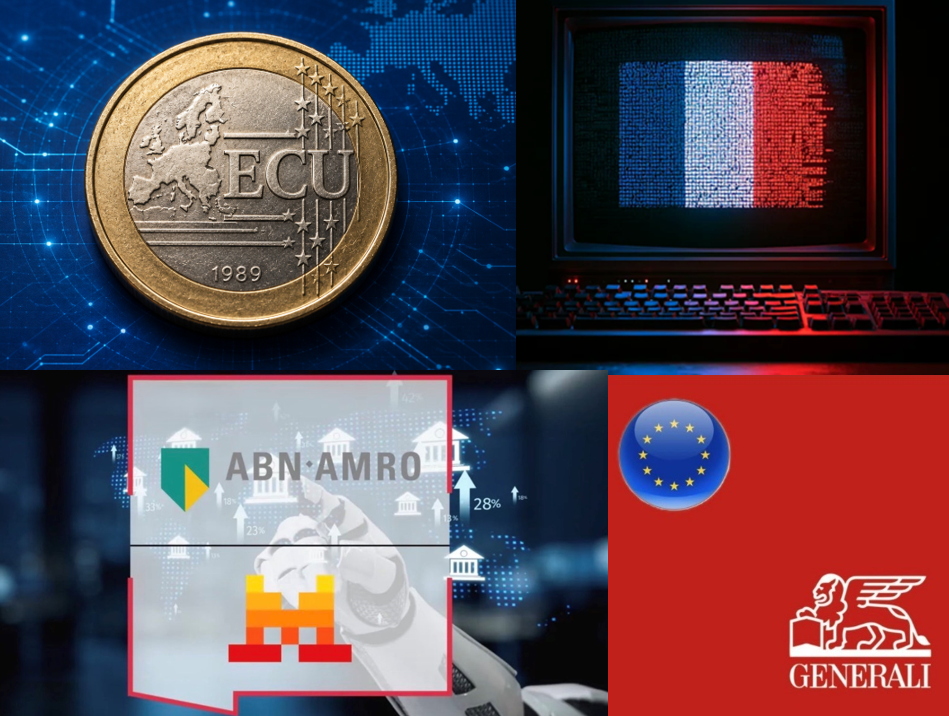
Critically we are also seeing the private sector beginning to move, as Boards are faced with the pressures of AI transformation intersecting with the sovereignty question: “how do we deploy AI? and how do we deal with dependencies?”. Dutch Bank ABN AMRO announced earlier this month it is adopting Mistral’s AI models into its banking services “to improve operational efficiency and support European technological sovereignty”. This is a clear statement by a flagship European bank it is not adopting a hyperscaler AI solution, but a European alternative because it is European. Significant because it uses the opportunity of AI transformation to explicitly say it is supporting sovereignty. The Dutch Central Bank, as well as HSBC and BNP Paribas, have also shifted to European solutions. Other European banks and insurance companies are beginning to move – but also construction companies, retailers and more. Indeed in cooperation with aDRI (aDRI – Digital Resilience Index) we are involved in multiple other cases where the process of evaluation and search for alternatives is underway. Including forming “buy clubs” and issuing joint RFPs. There is reluctance to report this publicly for fear of commercial reprisals by hyperscalers, but the mountain is moving.
– Mistral is aggregating demand to build own infrastructure: while we are not enamoured with Mistral’s collaboration with Microsoft, we recognise that Mistral as the prime European AI play has understood that what Europe needs is infrastructure, not “just” models. It announced last weeks plans to put in place 1 GW of compute by 2030 supported by customers committing for 5 years to European Compute Units (ECUs) of Mistral compute capacity. No details on customers and terms are available at this point, but as a general principle using ex-ante demand commitments as predictable flows to fund new infrastructure is an established financing model for infrastructure everywhere (from energy to renewables). In effect, Mistral is aggregating smaller customer demands for compute to build the equivalent of an “anchor customer“ – bankable to finance its compute infrastructure. Recognising that the power Europe needs is asset buildout, Mistral thus expands from model builder to full(er) stack player. While there have been also negative reads of this move (inevitable)[1], putting focus on the demand side is critical: one criticism of the Commission’s Gigafactories project has been precisely that it subsidizes vendors but has not sufficiently factored in the need to secure demand will come forward for this capacity. Good move for Mistral and sovereignty – we need a lot more.
– Private capital is organizing: lack of growth finance is the perennial European scourge: institutional funders claim to be hemmed in by rules and regulations, in addition to risk aversion, and have not traditionally “talked to VCs” – ventured into funding European plays. Tech founders are not so much hampered by Big Tech in their ability to scale up (the persistent fixation of Europe’s regulation complex), but by demand friction and lack of finance (a new paper shows just this very graphically, and confirms it is worse in tech than other sectors – not surprising to anyone here). `
There are signs however this may be shifting: pension funds are debating how the “investible window” for them may be moving so they may venture into new territories; insurance companies are starting to make small but explicit pledges (see Generali’s announcement in July of a 300m Euro “European Sovereignty Programme”), we are seeing movement from family offices (stay tuned) and sovereign funds. The Commission has set up a “Scale Up Fund” for 5bn Euro, which is nice in the scheme of things though European infrastructure requirements should not really need the EC to prop up funding (and consumer app Lovable, one of the first allocations of this fund, seems more about PR than truly supportive of the original “infrastructure” mission).
Where are the weak links? We still do not see European enterprise (our large industrial champions) punching their weight in the sovereignty drive. The narrative is very garbled too. It would be great to see our captains of industry coming out swinging and saying “here you go, we are pledging X billions to help build European tech”. Instead when they speak out they are very cagey. The narrative tends to be: “we should all love each other and Europe should be a “connector” between blocks, not strive for isolationism and “keep others out”. But this is a bizarre and unnecessarily defensive posture. It is not the EuroStack position. We understand European industry is scared of upsetting global clients (and the US Administration) and is sending out olive branches. But as we said many times, let’s not confuse what we are pushing for (“let’s build, aggressively and urgently”) with autarky or protectionism or indeed “keeping others out”. We would love to see our European enterprise standing up to be counted: “we are global firms but also proud Europeans and will invest XXbn in European tech”. Amen and godspeed.
We’ll report back soon on EuroStack 2.0, but again, the mountain is moving.
[1] A more negative read is Mistral are admitting they are exiting the race for frontier models (Anton Leicht). Another one the inevitable observation 1 GW is not much in the scheme of things – but as we also say repeatedly, even limited incremental effort is worthwhile.