Mobilizing “Digital Commons” for European Industrial Sovereignty
The launch of the Digital Commons EDIC (DC-EDIC) by France, Germany, the Netherlands, and Italy last week in The Hague is a welcome recognition of digital sovereignty as a key goal for Europe, hopefully beyond promises and speeches (Digital Commons EDIC launches to advance Europe’s technological sovereignty | Shaping Europe’s digital future). For the EuroStack Initiative—the coalition of European digital businesses and experts focussed on digital sovereignty—the DC-EDIC represents a potential strong institutional ally in the quest for powering up Europe’s tech industry. While we believe only business and private capital can lead the way to shaping the future of the European tech industry, an institutional instrument can be important as long as it is not just a talk shop (“Digital Commons” has a very evocative civil society non-business ring to it…) and it operates under a strict principle of complementarity: acting as a market enabler and infrastructure guardian, and avoiding state-subsidized competition that would “crowd out” European private initiative.
What should this EDIC do? Some comments/suggestions from us to make their stated actions relevant and useful (see 29 October Statement: Commission to launch Digital Commons EDIC to support sovereign European digital infrastructure and technology | Shaping Europe’s digital future):
1. Unblocking the Market: the EDIC as a “Trusted Enabler”
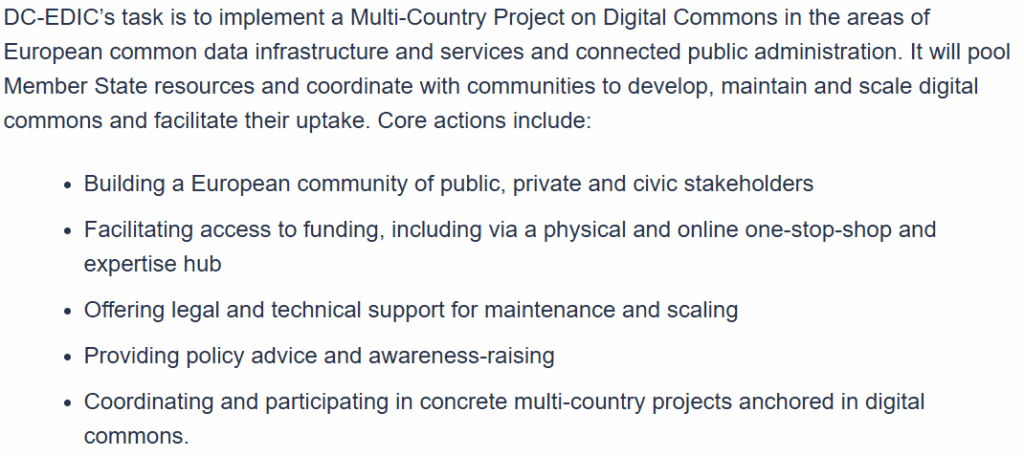
The DC-EDIC is not a central purchasing agency, but its mandate allows it to remove the structural friction that currently prevents public administrations from buying European solutions.
-
A “One-Stop-Shop” for Market Validation (Not Substitution):
-
-
-
-
- The Opportunity: The DC-EDIC’s planned platform to “promote sovereign alternatives” can function as a de facto “White List.” By referencing solutions that meet strict sovereignty and interoperability criteria as identified in the EuroStack Buy European Framework (A Proposed Framework for a “Buy European” Regulation of Strategic Digital Procurement – EuroStack), the EDIC signals to risk-averse Public CIOs that these tools are mature, legal, and secure. Additionally, it can work with the EuroStack-supported EuroStack Directory Project (EuroStack – European Open Solutions for Digital Sovereignty).
- The Safeguard: The platform must function as a directory of existing, active industrial-grade European solutions (the EuroStack ecosystem). It must not become a repository for new, state-funded “zombie projects”, especially when they duplicate what successful European SMEs are already developing and selling. The goal is to channel demand TO the market, not to bypass it.
-
-
-
-
De-Risking Migration via Technical Coaching:
-
-
- The Opportunity: The EDIC’s mandate to provide “technical and legal coaching” is potentially very useful. The EDIC can act as a Technical Assistance Facility, absorbing the “migration cost”—helping administrations map their dependencies, handle data portability, and design interoperable architectures.
- The Safeguard: This support must be neutral and focused on standardization. By guiding buyers toward open protocols (e.g., Matrix, OIDC, ActivityPub), the EDIC can create a level-playing field where private EuroStack vendors can compete on quality, rather than being locked out by proprietary legacy systems.
-
-
2. Sustainable Funding: The “Upstream” Mandate
The EuroStack ecosystem rests on a foundation of open source code (libraries, kernels, standards) that is often under-funded. The DC-EDIC, working with the Sovereign Tech Fund, is well placed to secure this “Digital Commons” layer, provided it adheres to the Market Investor Principle.
-
-
Funding the “Non-Commercial” Commons:
-
- The Opportunity: Following the German model (ZenDiS/Sovereign Tech Agency), the DC-EDIC should provide stable, multi-year funding for the maintenance, security hardening, and standardization of critical upstream components. This reduces the “technical debt” for all European companies and secures the supply chain.
-
- The Safeguard (Strict Subsidiarity): To avoid litigation risks associated with State Aid, the DC-EDIC must intervene only in areas of proven market failure or risk of default—specifically, the non-economic layers where no business model exists for European companies.
-
- Red Line: The EDIC should not use public funds to develop user-facing software products (e.g., a “State Office Suite”) that compete directly with Commercial Off-The-Shelf (COTS) products offered by European SMEs. Public money must leverage private value, not destroy it.
-
- Legal Risk: Such activity would expose the EDIC to litigation under EU State Aid rules (Article 107 TFEU). Where private European solutions already exist, there is no “market failure” to justify public intervention. Using state resources to duplicate these solutions would constitute a distortion of competition, effectively using public money to destroy private value rather than leverage it.
-
- The Safeguard (Strict Subsidiarity): To avoid litigation risks associated with State Aid, the DC-EDIC must intervene only in areas of proven market failure or risk of default—specifically, the non-economic layers where no business model exists for European companies.
-
-
3. Governance & Leadership: Critical Factors
For the DC-EDIC to fulfill its potential without disrupting the market, the “Who” and the “How” are critical. The leadership role should not be a purely administrative appointment, but requires a combination of technological depth, business acumen, legal authority, and community legitimacy. To navigate the complexity between the “Commons” (public good) and the “Ecosystem” (private sector), the Director must possess a specific track record in four distinct areas: deep technical literacy to bridge the gap between academic research and industrial application; economic enablement & acceleration, understanding of business models, financing, and the reality of the private sector; strong institutional credibility; and grassroot legitimacy – not an outsider imposed on the ecosystem but someone with the credibility to mobilize the developer community effectively.
EuroStack is willing to play a Consultative Role within the DC-EDIC governance structure: constant feedback from the industry is required to ensure that EDIC initiatives (Hackathons, calls for tenders) address actual market gaps rather than becoming theoretical or niche exercises.
Conclusion
The DC-EDIC can be an ally to EuroStack. By handling the “market friction” (legal uncertainty, interoperability standards, upstream maintenance), it can clear the runway for European companies to scale. We also see a clear division of labor:
-
- The DC-EDIC secures the Commons (the invisible yet fundamental infrastructure and standards).
- The EuroStack Industry builds and sells the Products (the value-added solutions).
If the DC-EDIC operates under these conditions, it can be a useful contributor to Europe’s digital recovery.